Explore the clue before you choose.
Explore categories instead of guessing blindly
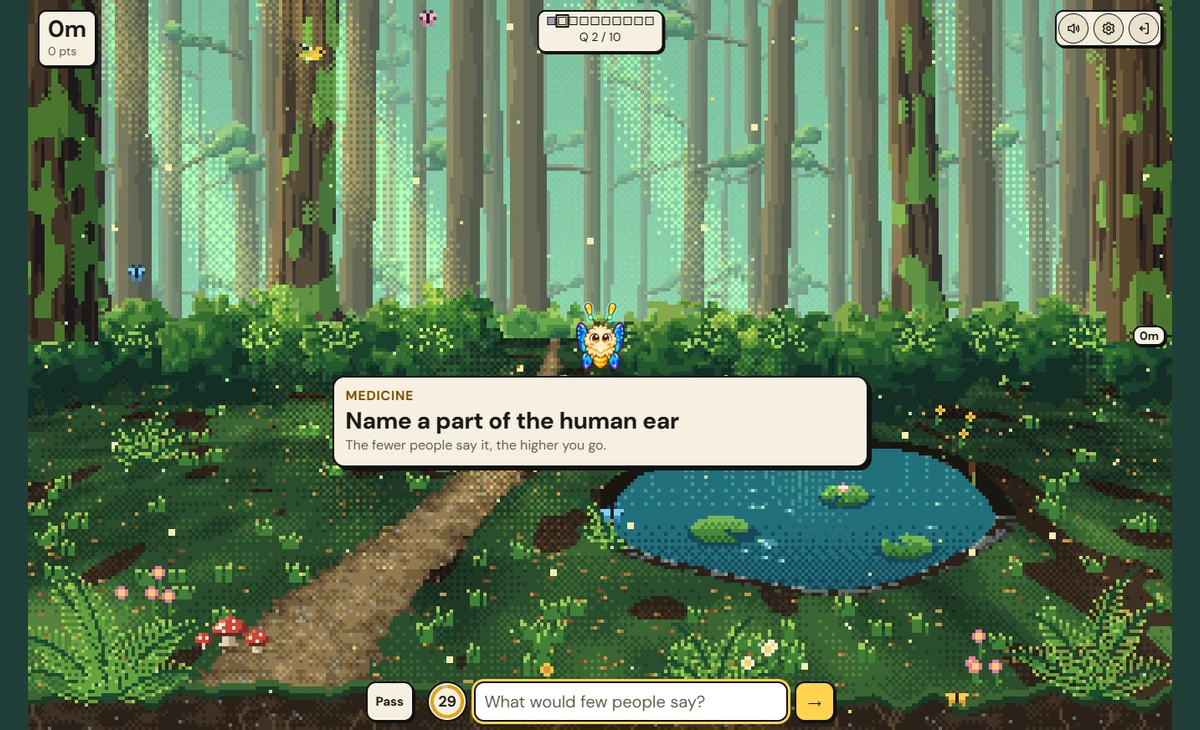
Players who enjoy geography clues already know that a plausible answer is not always a qualifying answer. A country can be familiar yet fail a border condition. Medical Krillion creates a similar reading challenge with medical vocabulary: the term you recall must belong to the group requested by the prompt. The subject changes, but the useful habit remains the same. Read the boundary first, then search within it.
This page is a guide to the Crowdict-hosted edition, embedded above for direct play. It offers Rare and Crowd, ten questions in a solo round, and up to thirty seconds per prompt. It is distinct from the independent geography and word games elsewhere in this collection. Their scores, question sets and saved progress do not merge with this player, even when a mode name sounds similar.
The guide is organised like a small field notebook. First identify what the clue asks for, then decide how to search your memory, and finally check what the response tells you. The interactive scope exercise uses language categories rather than live answers, so you can practise reading without seeing spoilers for an upcoming round. You can skip the notebook and start immediately whenever you prefer.
Find the anchor word in a prompt
An anchor word names the type of answer required. It might ask for a structure, an activity, a setting or a role. Identify that word before looking for a candidate. Then look for modifiers that limit the answer further, such as a particular region or context. In open-answer trivia, these small words carry more weight than the broad subject label displayed above the prompt.
Imagine being asked for a place where a particular activity happens. Supplying the name of a person who performs it may show that you understand the topic, but it answers a different category. This example illustrates sentence reading rather than a real question from the current game. The scope sorter on this page lets you compare the requested answer type with a chosen response type and explains the mismatch.
If a long question feels difficult, break it into two checks: what kind of thing is wanted, and which condition must it satisfy? You can do this mentally without taking notes. Avoid translating the prompt into a broader question that is easier to answer. A narrow correct interpretation gives you fewer candidates, but it also reduces the risk of choosing something that merely belongs to the same general subject.
Search a category in a useful order
Once the boundary is clear, use a repeatable route through your memory. For a spatial category, think through nearby parts in an order you recognise. For roles, picture a setting and consider who works there. For vocabulary, recall a pair or group of terms you learned together. A route gives you something concrete to try when the first obvious candidate does not appear.
Keep the route short enough for a timed game. You are looking for one response, not rebuilding a complete textbook chapter. If you already have a confident candidate, hold it as a fallback while exploring another possibility. This is especially helpful in Rare, where a second valid candidate may be more interesting than the first. It also stops a broad search from consuming all of the typing time.
There is no need to force the same technique onto every topic. A visual image may help with one prompt, while a familiar phrase helps with another. After a round, notice which kinds of cue were useful. The objective is to make recall easier under the game’s conditions, not to claim that a particular memory technique guarantees a score or improves a formal examination result.
Keep a separate map for Rare and Crowd
The mode controls your destination. In Rare, you are looking for a valid response that fewer players would offer. In Crowd, you are looking for a valid response that more players would offer. Both routes start with understanding the clue. Neither mode asks you to ignore a condition or submit a word only because it sounds associated with medicine.
A good Rare candidate is something you know clearly enough to type and defend within the category. A good Crowd candidate often feels familiar and easy to recognise. These are starting heuristics, not the provider’s scoring formula. The website does not have access to a complete live answer database or verified respondent counts, so the diagrams explain relative strategy without presenting numerical popularity as established fact.
When moving from the geography game to Medical Krillion, take a moment to reset your expectations. Do not assume that country-ranking rules, five-stop rounds or editor-estimated geography weights apply here. The selected external player determines its own timing and results. The collection groups games for discovery; it does not standardise them behind a single scoring system.
Make one answer easy to recognise
The answer field is a place for a clear term, not an explanation of your reasoning. Enter one candidate and check that it still matches the anchor word you identified. Multiple alternatives separated by punctuation may leave the intended response ambiguous. If you are thinking of a specific named thing, use the clearest form you know rather than a broad related word.
Spelling and abbreviations deserve attention because similar terms can refer to different things. Prefer a full expression when a short form could mean several things. The player may offer matching or correction feedback, but this guide cannot guarantee every variant in its database. Read any suggested correction before accepting it. A suggestion should preserve your intended meaning, not simply look familiar.
For language practice, begin with terms you can recall in the language shown by the player. Do not assume that a translated answer or a phonetic spelling will be recognised. You can still use the game to notice gaps in your vocabulary, but a mismatch is not a reliable measure of subject knowledge by itself. The prompt, your wording and the game’s coverage all matter.
Understand what a result can tell you
A result is evidence about the response submitted in that game. It is not a complete explanation of the subject. When a response is accepted, check whether its relative outcome fits the mode you chose. When it is not accepted, review the prompt and the exact word you entered before deciding what went wrong. This separates reading mistakes from spelling issues and possible coverage gaps.
Ask yourself a narrow question after each difficult prompt: did I answer the requested type of thing? If the answer is no, the next improvement is reading, not memorising more examples. If the type was right but the wording was unclear, the next improvement is expression. If both look sound, use the provider’s feedback mechanism where available instead of assuming the page can edit the remote database.
The guide and its scope sorter never send your practice selections to the game. They cannot award points, correct a completed result or preserve an external attempt. Keeping these boundaries visible prevents a common misunderstanding: changing a setting in an explanatory tool does not change the live player above it. Use the actual game controls for every in-round decision.
Plan a short exploration session
A useful first session can be as simple as playing one round and observing where you hesitate. Start with the mode whose objective is clearest to you. Focus on noticing the requested category and committing a readable answer. You do not have to know every topic to learn how this edition presents its prompts, responds to input and moves between questions.
On the next attempt, change one part of the process. You could read the condition more carefully, leave more typing time, or look for a second candidate before choosing. Changing one habit makes the outcome easier to interpret than simultaneously changing mode, device and answer strategy. The game offers further rounds, but the page makes no promise that every future question will be entirely new.
If the subject leads you toward a factual question outside the game, use an appropriate learning resource afterwards. Medical trivia is not a substitute for a course, professional judgement or personal healthcare advice. Keep sensitive details out of the answer field. This is a public recreational experience built around short responses, not a private place to discuss a patient or ask for diagnosis.
Move between the player and the collection
The frame stays near the top of the page so returning players can begin without scrolling through the guide. Use the short jump links when you want the scope tool or a particular explanation. On a narrow device, a direct player tab can offer more room for typing. Fullscreen depends on browser support, and a blocked request should lead you to the direct-open option rather than a dead end.
The hub’s cards help you discover games; any favorites or recently opened entries belong to this website’s browsing features. They should not be confused with completed rounds or a remote account. Likewise, reloading the embedded document can interrupt play. Use that recovery control only when loading has stalled or you intend to reopen the game, not as a way to save a result.
For a different challenge afterwards, return to Farflung map clues, the common-answer game, the rare-answer dive or the history-year challenge. Each asks you to interpret a different kind of evidence. Medical Krillion adds category-based vocabulary recall to that collection while retaining its own provider, controls and scoring. The shared thread is curiosity and a careful reading of the clue.